Composable, Not Monolithic: The Case for Modular Demand Infrastructure
Monolithic demand platforms promise to do everything. In practice, they lock your workflow to their roadmap and their pricing model. Composable infrastructure starts with what you need and adds the rest when you need it.
The Monolith Promise
Demand infrastructure is typically sold as a monolith. One platform. One login. One contract. Everything from data sourcing to campaign execution to reporting in a single product with a single support team.
The promise is simplicity. Sign one contract, get one integration, avoid the coordination cost of stitching separate tools together.
The reality is different.
What Monolithic Platforms Actually Deliver
A monolithic platform delivers everything at the level of its weakest capability. The enrichment quality is constrained by whatever data partnerships the platform has negotiated. The personalisation layer is whatever the product team prioritised in the last two roadmap cycles. The reporting is built around the metrics the platform cares about, not the ones your clients ask for.
When one capability does not meet your requirements, you have three options: wait for the roadmap to catch up, use a workaround that adds manual effort, or bring in a separate tool that now has to integrate with the monolith you just committed to.
That integration cost was supposed to be the thing you avoided by buying the monolith in the first place.
The Pricing Trap
Monolithic platforms charge for the whole platform even when you are only using part of it. The enrichment capability you actually need is bundled with a campaign builder you will never touch and a reporting module your clients do not ask for.
As your volume grows, every capability scales in price simultaneously, including the ones you do not use. The platform has no incentive to unbundle, because bundling is what prevents you from leaving.
The Composable Alternative
Composable infrastructure starts from the opposite assumption: a buyer needs specific capabilities at specific volumes, and those needs will change.
A composable approach means each capability is independently deployed, independently priced, and independently scalable. You start with enrichment because that is what you need today. When your clients start asking for personalised landing pages, you add that capability to the pipeline. When the next client requires branded asset delivery, you compose that in.
Each addition is a configuration, not a rebuild.
What Composable Means in Practice
Composable does not mean assembling a patchwork of unrelated vendors. That produces a different problem: the integration surface becomes your responsibility, and maintaining the connections between five separate APIs is a full-time job.
Composable means capabilities that are designed to chain together. Enrichment outputs feed directly into personalisation inputs. Personalisation outputs feed directly into asset delivery. The pipeline is one sequence with multiple stages, not five separate products run in parallel.
The distinction matters at scale. An integrated composable pipeline runs faster, fails less often, and produces consistent output across every account in a batch. A patchwork of vendors requires a coordinator who understands all five systems and catches the failures between them.
The Vendor's Specific Requirement
For lead vendors reselling intelligence and personalised assets to clients, the composable question is particularly concrete.
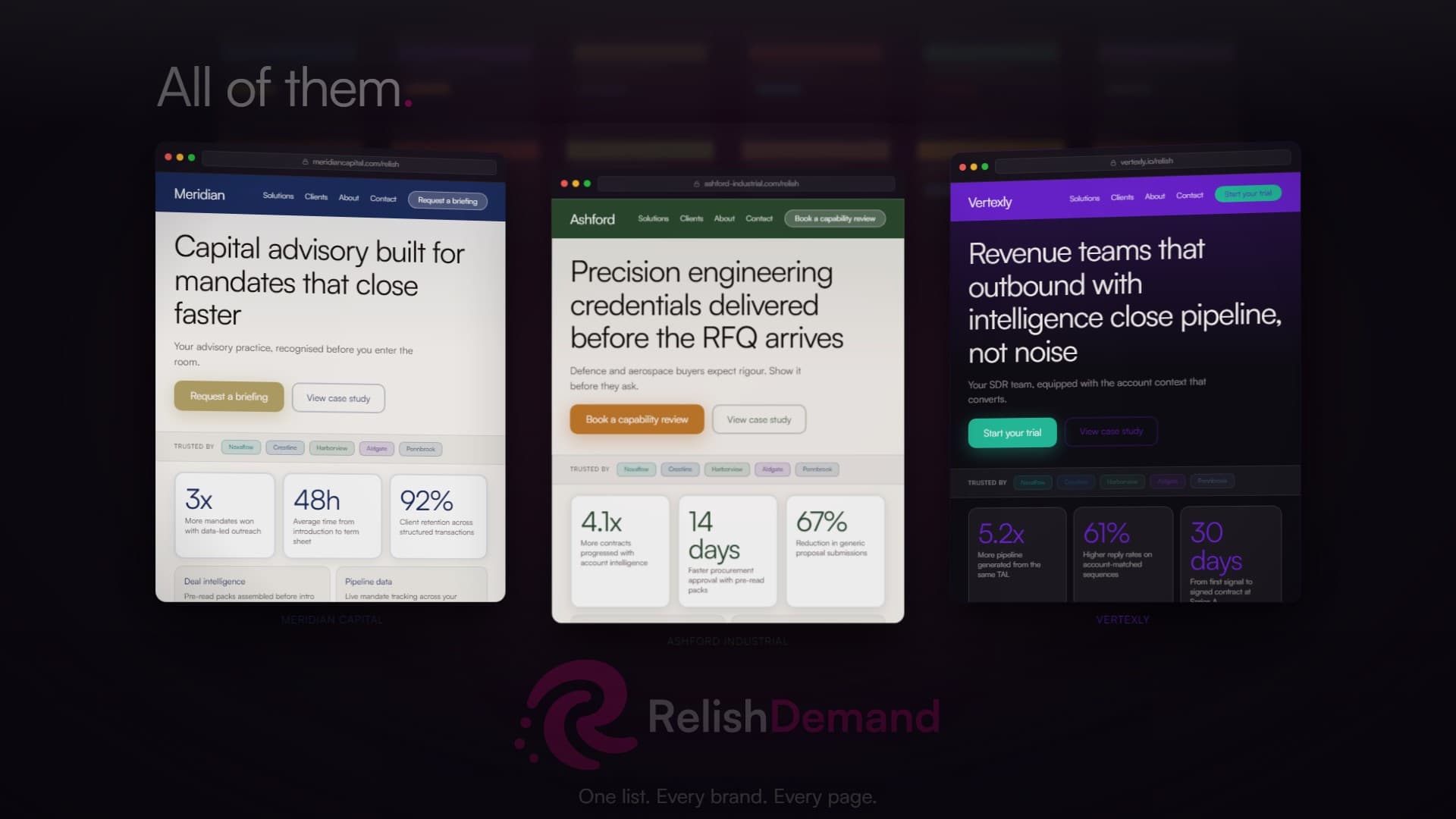
The vendor's delivery pipeline needs to accept a target account list and return: enriched profiles, intent scores, personalised landing pages, and branded asset packages. The client does not care how many systems run underneath. They care that the output is consistent, fast, and branded to their account.
A monolithic platform that covers three of those four requirements forces the vendor to maintain a separate integration for the fourth. A composable infrastructure that covers all four as connected stages means the vendor operates a single pipeline from list to delivery.
Starting with One Capability
The composable model also changes the procurement decision. A vendor who needs enrichment today does not have to commit to a full platform contract to get started. They start with enrichment, run the volume they have, and add personalisation when the client opportunity justifies it.
This removes the typical buy-the-whole-platform-before-you-need-it decision that most SaaS contracts require. The infrastructure grows with the vendor's capacity and client demand, not ahead of it.
The Consolidation Argument
There is a version of the composable argument that sounds like the monolith argument: eventually, composable infrastructure consolidates onto a single vendor, and at that point you are back to a monolith.
The difference is direction of travel. A monolith locks you in at purchase. Composable infrastructure lets you consolidate after you have validated what you actually need.
The vendor who starts with enrichment, validates the output quality, adds personalisation when it is needed, and composes in asset delivery when the client base demands it has built a pipeline around proven requirements. The vendor who bought the monolith on day one has been paying for capabilities they did not need yet, built for a use case that evolved during the contract.
Composable infrastructure is not an argument against integration. It is an argument for integration that follows capability validation, not pricing pressure.